
ReWorld: An Interactive World Model with Long-Horizon Memory
Zhifei Chen, Luozhou Wang, Guibao Shen, Dongyu Yan, Shuai Yang, Tianshuo Xu, Yihua Du, Wei Wang, Tianyi Gui, Lianghua Huang, Yingcong Chen
Read on arXiv →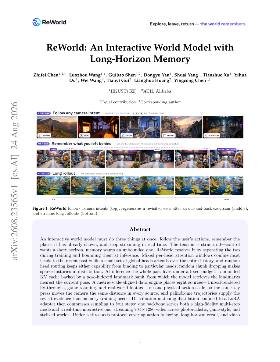
Key claim
ReWorld balances control and memory for interactive models.
In plain English
Imagine you're building an AI that needs to navigate and interact with a dynamic environment, like a video game or a virtual world. The challenge lies in making sure the AI can remember where it has been and respond to user actions in real time. Current models often struggle with this because they either focus too much on short-term control or try to remember everything, leading to issues like losing track of context or being unable to adapt to new situations — this is what's called the control-memory tension. To address this, ReWorld introduces a method that separates the short-term control from long-term memory during training, allowing the model to handle both effectively at inference. It uses a mix of attention mechanisms, where most heads focus on recent actions while a few can access the entire history, and employs techniques like random head routing and chunk dropping to maintain a sparse but relevant memory. This way, when the model is in action, it can efficiently retrieve important past information without overwhelming its memory capacity. Compared to previous models, ReWorld achieves better control fidelity and generation quality, making it more reliable for real-time applications. This means that for developers building interactive systems, ReWorld offers a more robust framework that can handle complex tasks without losing track of context, ultimately leading to a smoother user experience.
The approach of separating control and memory during training is a meaningful extension in interactive world models.
The evaluation against six recent models provides solid comparative metrics, though some aspects could be more rigorously tested.
Deep reliability assessment
The methodology supports the claim of improved control fidelity and memory recall by using mixed attention windows and a fixed KV cache, but the generalizability to all interactive world models may be overclaimed without broader testing.
Reproducibility
yes, the paper provides a website link which likely contains code or further resources: https://zhifeichen097.github.io/ReWorld/
Key figure
Figure 1 illustrates ReWorld's ability to follow camera intents, regenerate revisited views, and stream long rollouts.