
OmniScientist: An Omni-Modal Omni-Discipline AI Scientist
Bobo Li, Hao Fei, Tianjie Ju, Mong-Li Lee, Wynne Hsu
Read on arXiv →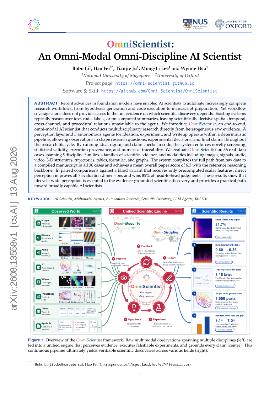
Key claim
Lifecycle-wide perception is essential for scientific discovery.
In plain English
Imagine you're a researcher trying to make sense of a mountain of diverse data — images, audio, tables, and more — to generate new scientific insights. Currently, most systems focus on analyzing text or precomputed summaries, which often leads to missing critical relationships and insights that could be gleaned from the raw data itself. This limitation can result in incomplete or biased conclusions, a problem known as data silos, where valuable information is left untapped. The OmniScientist addresses this by integrating a perception layer that allows it to process and reason over various types of raw evidence directly, rather than relying solely on preprocessed inputs. It employs three autonomous agents that handle ideation, experimentation, and manuscript writing, creating a seamless workflow that adapts based on real-time observations and findings. This holistic approach not only enhances the research process but also ensures that the results are grounded in comprehensive evidence. Compared to existing systems, OmniScientist's ability to operate across multiple modalities and maintain a continuous feedback loop throughout the research lifecycle marks a significant advancement, making it a valuable tool for anyone looking to push the boundaries of scientific discovery.
OmniScientist introduces a comprehensive, omni-modal approach to scientific research.
The evaluation across diverse real-data cases supports its effectiveness.
Deep reliability assessment
The methodology supports the automation of research workflows from raw data to manuscript preparation, but the claim of lifecycle-wide perception being essential for evidence-grounded discovery may be overclaimed without broader validation.
Reproducibility
Yes, the paper mentions open source code and datasets. The GitHub repository is provided for access to the software and skills.
Key figure
Figure 3 illustrates the architecture of the OmniScientist framework, showing how raw evidence from multiple disciplines is processed through ideation, experimentation, and writeup stages.