
Beyond Top-K: Replacing Black-Box Retrieval with Interpretable Agentic Operations
Sagar Tamang, Ayush Vyas, Tabarakul Hazarika
Read on arXiv →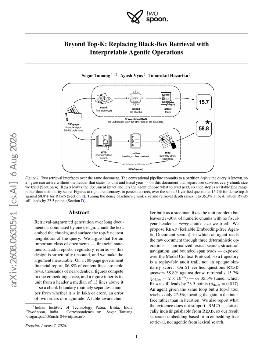
Key claim
READ outperforms traditional retrieval methods in complex documents.
In plain English
Imagine you're trying to extract meaningful insights from a lengthy financial report filled with tables and figures. The common approach is to break the document into chunks, embed those chunks, and then find the most relevant pieces based on similarity to a query. However, this method often fails when dealing with structured data like financial statements, where context is crucial. For instance, a number might be misinterpreted if it’s separated from its unit, leading to significant errors in understanding the data. This is what's called the 'unit problem', and it highlights a major flaw in the chunking strategy used today.
To address these issues, the authors propose a new method called READ, which stands for Reliable Embedding-free Agentic Document-search. Instead of relying on embeddings, READ processes the document through a series of deterministic operations that focus on understanding the structure and content of the text. This allows it to maintain context and accurately interpret the data, leading to a much higher accuracy in answering questions compared to traditional methods. In their experiments, READ significantly outperformed dense retrieval methods, showing that the interface and approach to document navigation are critical for effective information retrieval. For anyone building systems that need to work with complex documents, this approach offers a promising alternative to conventional embedding-based methods.
The approach fundamentally shifts how document retrieval is handled, especially for complex structured data.
The results are backed by statistical comparisons against established methods, demonstrating solid performance.
Deep reliability assessment
The methodology supports the claim that embedding-free retrieval can outperform dense retrieval for certain document types, but it does not establish superiority over all retrieval methods.
Reproducibility
No open source code or dataset is mentioned in the paper.
Key figure
Figure 1 compares two retrieval interfaces over the same document, showing accuracy percentages for dense top-k retrieval versus the READ method.