
Three-Body Scattering for Generative Modeling
Peng Sun, Zhenglin Cheng, Deyuan Liu, Jun Xie, Xinyi Shang, Tao Lin
Read on arXiv →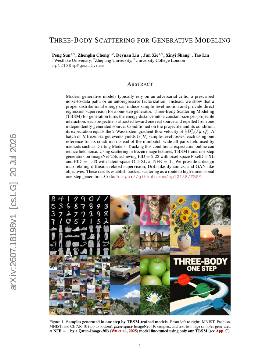
Key claim
TBSM enables efficient one-step generation with reduced noise.
In plain English
Generative models often depend on adversarial critics or autoregressive methods, which can limit their efficiency and effectiveness. Current techniques may struggle with noise and require complex pairwise interactions. This paper introduces a new method, TBSM, that simplifies the interaction model and improves sample-level generation by using energy distances. Builders might find this approach valuable for developing more efficient generative models that can handle high-dimensional data with reduced noise.
Introduces a novel approach to generative modeling using energy distances.
Demonstrates solid results on ImageNet with clear methodology, though lacks extensive baselines.
Deep reliability assessment
The methodology supports high-dimensional one-step generation using a novel three-body scattering approach, but the claims of achieving state-of-the-art results may be overclaimed without broader empirical validation across diverse datasets.
Reproducibility
Yes, the paper provides open source code and mentions the use of ImageNet-256 dataset.
Key figure
Figure 1 shows samples generated in one step by TBSM-trained models across various datasets including MNIST, Fashion-MNIST, CIFAR-10, and ImageNet-1K.