
4DR360: State Reasoning for Joint 3D Detection and Occupancy Prediction in 4D Radar-Camera Full-Scene Perception
Xiaokai Bai, Lianqing Zheng, Runwei Guan, Songkai Wang, Siyuan Cao, Hui-liang Shen
Read on arXiv →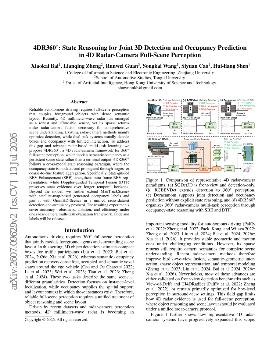
Key claim
New framework enhances radar-camera scene perception.
In plain English
Reliable autonomous driving needs to understand the entire scene, but current methods often focus only on detecting objects without fully integrating the surrounding environment. Existing radar-camera systems struggle with sparse data and limited interaction between tasks. This paper proposes a new framework that treats occupancy as an ongoing state, improving how information is processed and shared between radar and camera inputs. Builders might care because this approach could lead to more accurate and robust perception systems for autonomous vehicles.
The paper introduces a novel cross-modal state reasoning paradigm for radar-camera fusion.
The experiments cover multiple aspects of performance, though specific baselines are not detailed.
Deep reliability assessment
The methodology supports the claim that 4DR360° improves detection and occupancy prediction through state reasoning, but the paper may overclaim its generalizability to all adverse conditions without extensive testing across diverse environments.
Reproducibility
No open source code or dataset URL is provided in the paper.
Key figure
Figure 1 compares different 4D radar-camera paradigms, highlighting the unique features of 4DR360° such as 360° perception, multi-task learning, and state reasoning.