
UniClawBench: A Universal Benchmark for Proactive Agents on Real-World Tasks
Zhekai Chen, Chengqi Duan, Kaiyue Sun, Bohao Li, Yuqing Wang, Manyuan Zhang, Xihui Liu
Read on arXiv →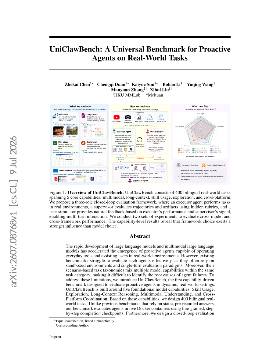
Key claim
UniClawBench enables realistic evaluation of proactive agents.
In plain English
Imagine you're trying to build an AI that can assist people in their daily lives, like managing tasks or providing information. The challenge is that existing methods for evaluating these AI agents often fall short because they test them in controlled environments that don't reflect real-world complexity. For instance, they might only look at how well an agent performs in a single interaction, missing out on how it handles ongoing tasks or adapts to new situations. This is what's called a limitation in evaluation paradigms.
To tackle these issues, the authors created a new benchmark called UniClawBench. This benchmark is designed to evaluate proactive agents based on their ability to perform a variety of tasks in real-world settings. It focuses on five key capabilities: how well the agent uses its skills, explores new information, reasons over long contexts, understands different types of data, and coordinates across platforms. By designing 400 bilingual tasks that reflect these capabilities, they can assess agents more effectively.
What sets UniClawBench apart is its live evaluation method, where agents are tested in real-time using Docker containers. This allows for a more realistic assessment of their performance, as agents are evaluated step-by-step rather than just on final outcomes. The authors also implemented a closed-loop evaluation strategy that simulates human feedback, which helps in understanding how agents can improve over time. Overall, this new approach provides a clearer picture of how different model capabilities and design choices impact agent performance, paving the way for better AI systems in practical applications.
The introduction of a capability-driven benchmark for proactive agents is a significant advancement in evaluating their performance in real-world scenarios.
The paper provides a solid evaluation framework with comprehensive task design and multiple agent frameworks, ensuring robust comparisons.
Deep reliability assessment
The methodology supports evaluating proactive agents in dynamic real-world settings through a capability-driven benchmark, but the claim of capturing true real-world complexity may be overclaimed due to the inherent limitations of simulated environments and the absence of stable ground truth.
Reproducibility
Yes, the paper provides open-source code and benchmark tasks at https://github.com/HKU-MMLab/UniClawBench.
Key figure
Figure 1 provides an overview of UniClawBench, illustrating its structure with 400 bilingual real-world tasks across five core capabilities and the three-role closed-loop evaluation strategy.