
Efficient Compression of Structured and Unstructured Volumes via Learned 3D Gaussian Representation
Landon Dyken, Sharmistha Chakrabarti, Nathan Debardeleben, Steve Petruzza, Qi Wu, Will Usher, Sidharth Kumar
Read on arXiv →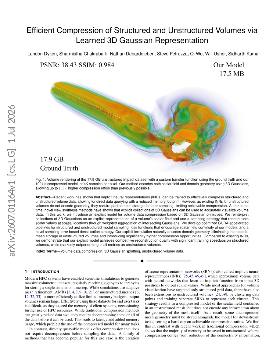
Key claim
New model compresses volume data with higher efficiency and quality.
In plain English
Imagine you're working with large sets of volume data, like 3D medical scans or simulations. The challenge is that while you want to store this data efficiently, existing methods often require keeping extra geometry information, which can take up a lot of space. This is especially true for unstructured volumes, where the data isn't neatly organized. When you try to compress this data, you often end up sacrificing quality or needing to store additional mesh data, which complicates things. This is what's called the geometry encoding problem.
Now, what if there was a way to represent this volume data without needing to keep that extra geometry? This paper introduces a clever approach that uses collections of 3D Gaussians to create a more explicit representation of the data. Instead of relying on implicit neural representations that don't capture geometry well, this method allows for direct querying and reconstruction of the data by aggregating the values from these Gaussians. This means you can compress the data more effectively without losing important details.
The results are promising: the new model not only maintains competitive quality in reconstructing structured volumes but also significantly outperforms existing methods for unstructured volumes. For anyone building applications that rely on volume data, this means you can achieve better compression and faster processing times, making your systems more efficient and easier to manage.
The paper introduces a new explicit model for volume data compression using 3D Gaussian primitives, which significantly advances the current understanding of implicit neural representations.
The claims are supported by competitive reconstruction quality and training speedup results, though the evaluation could benefit from more diverse datasets.
Deep reliability assessment
The methodology supports the claim of achieving higher compression ratios by using 3D Gaussian primitives to encode both scalar fields and domain geometry, eliminating the need for mesh storage. However, the claim of significantly higher compression opportunities may be overclaimed without detailed comparison metrics against a wide range of existing methods.
Reproducibility
no
Key figure
Figure 1 shows a volume rendering of the 17.9 GB unstructured Impact dataset using the ground truth and the 1024× compressed model, demonstrating the method's ability to encode both scalar field and domain geometry using 3D Gaussians.