
DynaKRAG: A Unified Framework for Learnable Evidence Control in Multi-Hop Retrieval-Augmented Generation
Yaqi Wu, Xiaolei Guo, Chenyu Zhou, Jiaqi Huang, Xianfa Zhang, Junxu Zhang, Zhuo Yu, Zhubo Shi, Jianghao Lin, Dongdong Ge
Read on arXiv →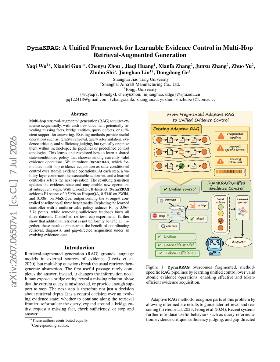
Key claim
DynaKRAG dynamically selects evidence operations for better retrieval.
In plain English
Imagine you're building a system that needs to gather information from multiple sources to answer complex questions. This is tricky because each piece of information might only provide part of the answer, and you need to figure out which pieces to look for next. Current systems often follow a set path, which can miss important connections or lead to unnecessary searches. This is what's called a rigid pipeline, and it can fail when the initial query doesn't capture all the needed details or when new information changes the context of the question.
What DynaKRAG does is rethink this process. Instead of sticking to a fixed sequence of operations, it learns to adaptively choose the best next step based on the current state of evidence it has gathered. It uses a validity layer to determine which actions are possible at each moment and a learned controller to select the most promising one. This means that as new documents are retrieved, the system can adjust its strategy, potentially uncovering new facts or correcting its course based on what it finds.
In practice, this approach leads to better performance on tasks like answering questions from datasets such as HotpotQA and 2Wiki. The key takeaway is that by allowing the system to dynamically adjust its evidence-gathering strategy, DynaKRAG significantly improves the quality of the answers it can provide, outperforming traditional methods that rely on fixed pipelines.
DynaKRAG introduces a new way to coordinate evidence operations in multi-hop retrieval, extending existing methods significantly.
The results are supported by strong baselines and multiple datasets, with clear ablation studies demonstrating the importance of its components.
Deep reliability assessment
The methodology supports the claim that DynaKRAG improves multi-hop QA by coordinating retrieval, diagnosis, and gap-directed acquisition under an evolving evidence state. However, the claim that additional retrieval is not uniformly beneficial may be overgeneralized without specific context.
Reproducibility
No open source code or dataset is mentioned in the paper.
Key figure
Figure 1 illustrates how DynaKRAG overcomes fragmented, method-specific RAG pipelines by learning unified control over valid atomic evidence operations.