
The State-Prediction Separation Hypothesis
Giovanni Monea, Nathan Godey, Kianté Brantley, Yoav Artzi
Read on arXiv →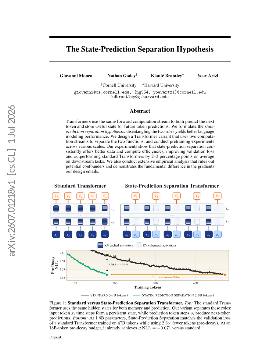
Key claim
Separating state and prediction improves language model performance.
In plain English
Imagine you're trying to build a language model that predicts the next word in a sentence. Traditional models, like Transformers, do this by using the same process to both make predictions and keep track of useful information for future predictions. This can lead to inefficiencies because the model is trying to do two things at once, which can cause it to struggle with complex tasks. This is what's called a bottleneck in performance.
The authors of this paper propose a solution by suggesting that if you separate these two functions — one stream for predicting the next token and another for storing state — you can actually improve how well the model performs. They designed a new variant of the Transformer that does just that, and their experiments show that this separation leads to better data and compute efficiencies. In practical terms, this means that their approach consistently reduces validation loss and achieves better results on various tasks compared to standard Transformers.
Overall, this new method not only enhances performance but also provides a clearer understanding of how different components of the model interact. For anyone building language models, this insight could lead to more efficient designs that save on resources while improving accuracy.
The paper introduces a new approach to language modeling by separating state and prediction functions, which is a significant extension of existing Transformer architectures.
The experiments are well-supported with empirical analysis and show consistent improvements across various scales and tasks.
Deep reliability assessment
The methodology supports the claim that separating state and prediction streams in Transformers improves efficiency and performance, but the generalizability to all language modeling tasks is overclaimed without broader testing.
Reproducibility
Yes, the paper mentions that the code is available at https://github.com/lil-lab/sps.
Key figure
Figure 1 compares the standard Transformer, which uses the same hidden states for memory and prediction, with the State-Prediction Separation Transformer, which separates these roles into distinct computation streams.