
Graph Machine: Towards Better Pretraining via Edges
Lintai Hou
Read on arXiv →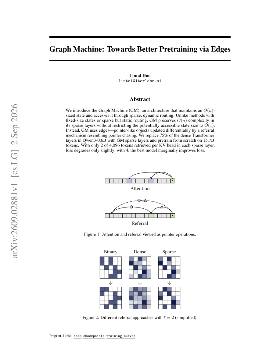
Key claim
Dynamic routing improves efficiency in state management.
In plain English
Imagine you're building a large-scale AI model that needs to process vast amounts of data efficiently. Traditional architectures often struggle with state management, either becoming too rigid with fixed-size states or too inefficient with static routing, leading to performance bottlenecks. This is particularly problematic when trying to scale models while maintaining speed and accuracy, which can result in what's called 'state explosion' or 'routing inefficiency.' These issues can hinder the model's ability to adapt and learn from new information effectively.
The Graph Machine (GM) architecture addresses these challenges by employing a dynamic routing mechanism that allows for sparse access to a state that grows linearly with the input size. Instead of being limited to a fixed number of connections, GM uses pointer-like objects that can be updated in a differentiable manner, enabling more flexible and efficient data retrieval. By replacing a significant portion of the dense layers in a Transformer model with these sparse layers, GM maintains performance while reducing computational overhead. The results indicate that even with a limited number of tokens retrieved per layer, the model's performance remains robust, showcasing a slight improvement in loss metrics compared to traditional methods.
This approach marks a meaningful shift in how we can design architectures for large-scale models, allowing builders to create more efficient systems that can handle larger states without sacrificing performance. For those developing AI solutions, GM offers a promising pathway to enhance scalability and adaptability in complex tasks.
The introduction of a dynamic routing mechanism in sparse layers is a significant advancement.
The experimental results show solid performance improvements with a clear methodology, though more baselines could strengthen claims.
Deep reliability assessment
The methodology supports the claim that the Graph Machine can replace dense Transformer layers with sparse layers while maintaining performance, but the improvements are modest and depend on specific configurations and hardware optimizations.
Reproducibility
No open source code or dataset is mentioned in the paper.
Key figure
Figure 1 illustrates attention and referral as pointer operations.