
LittleLearner: Language Models Under Pedagogically Controlled Knowledge Exposure
Fanfei Li, Jana Zeller, Manuel Prada-Corral, Thaddäus Wiedemer, Prasanna Mayilvahanan, Ryan Cotterell, Wieland Brendel
Read on arXiv →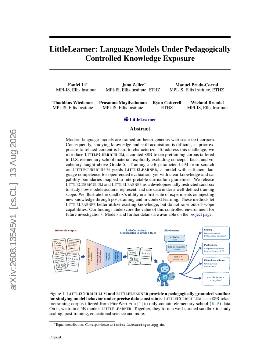
Key claim
LITTLECURRICULUM enables focused language model training.
In plain English
Imagine you're developing a language model that needs to understand and generate content suitable for elementary school students. The challenge lies in ensuring that the model's knowledge is appropriately limited to what a fifth grader would know, which is difficult when training on vast, mixed datasets from the internet. This often leads to models that can produce advanced responses or exhibit knowledge beyond their intended scope, which can be problematic in educational contexts — this is what's called overfitting to the training data. To tackle this, the authors created LITTLECURRICULUM, a carefully curated dataset specifically designed for U.S. elementary school material, ensuring that the model only learns concepts appropriate for that age group. By training a 5B-parameter model, LITTLELEARNER, on this dataset, they establish clear boundaries for what the model can and cannot do, making it easier to study how it acquires and uses knowledge. The controlled environment allows for targeted experiments, such as testing how well the model can learn new information after its initial training without expanding its knowledge base beyond the defined curriculum. This approach contrasts with traditional methods that often lead to models with unpredictable capabilities, providing a more reliable framework for educational applications.
The introduction of a curriculum-based training dataset for language models is a significant conceptual shift.
The experiments conducted provide solid insights, though more extensive validation could enhance reliability.
Deep reliability assessment
The methodology supports studying model behavior under controlled data constraints, but claims about extending capabilities beyond training exposure may be overclaimed.
Reproducibility
No open source code or dataset URL is mentioned in the paper.
Key figure
Figure 1 illustrates LITTLECURRICULUM and LITTLELEARNER as a sandbox for studying model behavior under precise data constraints.