
SM4RT: Learning Structured Motion Geometry for 4D Reconstruction
Shing Ho J. Lin, Wenzhao Zheng, Dong Zhuo, Yuqi Wu, Jie Zhou, Jiwen Lu
Read on arXiv →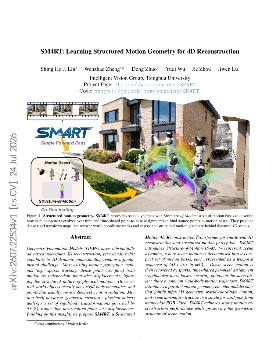
Key claim
SM4RT improves 3D reconstruction by understanding structured motion.
In plain English
Imagine you're working on a system that needs to understand how objects move in a video, like tracking a ball in a sports game. Current methods often treat each point in the scene as moving independently, which can lead to errors when objects are actually moving together, like a group of dancers or cars on a road. This disjointed approach can fail to capture the true dynamics of motion, leading to inaccuracies in 3D reconstruction and understanding of the scene. This is what's called treating motion as unstructured, which doesn't reflect the reality of how physical objects behave. To address this, the authors propose a new framework that recognizes the structured nature of motion. By using a concept called Structure-of-Motion, they decompose the motion of objects into a compact set of bases that represent how these objects move together in a coordinated way. Their model, SM4RT, processes monocular RGB video to jointly infer the 3D geometry and the motion of objects in a single pass, ensuring that points on the same object share a common motion trajectory. This approach not only improves the accuracy of motion perception but also preserves the geometric structure of the scene, making it a significant step forward compared to previous methods that treated motion as isolated.
The approach introduces a new way to understand and reconstruct motion in 3D space, leveraging geometric structures.
The method shows strong performance in motion reconstruction, though details on comparisons with existing methods could be clearer.
Deep reliability assessment
The methodology supports structured motion perception by decomposing scene motion into motion bases, but it may not fully account for complex interactions like collisions or fluid dynamics.
Reproducibility
yes, open source code is available at the provided GitHub URL.
Key figure
Figure 1 illustrates the SM4RT framework, showing how scene dynamics are represented with Structure-of-Motion using motion bases and point-to-base assignments.