
DiaLLM: An Investigation into the Robustness-Generation Gap in English Dialect Adaptation
Jordan Painter, Dipankar Srirag, Adarsh Kappiyath, Diptesh Kanojia, Aditya Joshi, Lu Yin
Read on arXiv →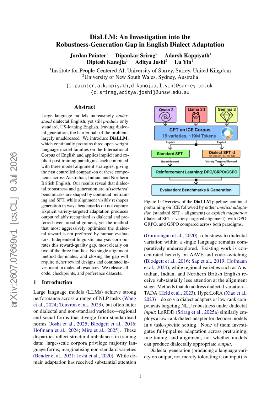
Key claim
Dialectal generation methods may not align with user preferences.
In plain English
Imagine you're building a language model that needs to understand and generate various English dialects, like Australian or Northern British English. While many models can understand these dialects, they often default to producing standard American English, which doesn't capture the richness of local speech. This is a problem because users want outputs that reflect their own dialects, but current models struggle to generate them accurately. This mismatch is what's called dialectal generation failure.
To tackle this, the authors introduce DiaLLM, a method that continually pretrains language models on a diverse set of dialects and applies different strategies to align the model's outputs with specific dialects. They found that simply improving the model's training isn't enough; the way you adapt the model to different dialects matters a lot. For instance, they discovered that while some methods make the model's outputs more recognizable as dialectal, they might not be what users actually prefer. This is a significant insight because it highlights that improving a model's performance on benchmarks doesn't always translate to better user satisfaction.
In practical terms, this means that if you're building applications that rely on generating text in various dialects, you need to consider not just how well the model performs on tests, but also how users perceive the quality of its outputs. The findings suggest that a more nuanced approach to training and adapting models for dialects could lead to better user experiences, but it will require ongoing effort and better reward designs to truly close the gap between model performance and user preferences.
The paper introduces a new approach to dialectal generation that combines continual pretraining and alignment strategies, addressing a significant gap in existing models.
The claims are supported by controlled comparisons across multiple dialects and the release of code and datasets for reproducibility.
Deep reliability assessment
The methodology supports the dissociation between dialectal robustness and generation, but overclaims on the ability to close the reward-quality gap without richer reward designs.
Reproducibility
yes, the paper mentions releasing all code, checkpoints, and preference datasets.
Key figure
Figure 1 provides an overview of the DiaLLM pipeline, showing continual pretraining on ICE followed by either implicit or explicit adaptation with different alignment strategies.