
DexCompose: Reusing Dexterous Policies for Multi-Task Manipulation with a Single Hand
Dihong Huang, Zhenyu Wei, Zhuxiu Xu, Yunchao Yao, Sikai Li, Mingyu Ding
Read on arXiv →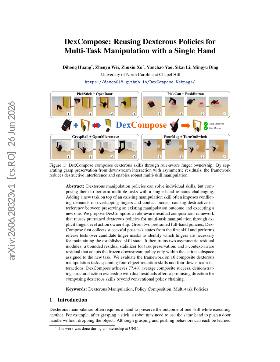
Key claim
DexCompose enables effective multi-task dexterous manipulation.
In plain English
Imagine you're trying to teach a robot to handle multiple tasks with a single hand, like picking up a cup while also holding a pen. The challenge is that when you add a new task, it can interfere with the skills the robot has already learned, especially when fingers need to work together in different ways. This is a common issue in robotics called destructive interference, where the demands of new tasks conflict with existing skills. For instance, if a robot is trained to hold a cup with its fingers, trying to add a task like writing with a pen can cause it to drop the cup or lose control of the pen. This is what's called task interference.
To address this, the authors propose a new method called DexCompose. The idea is to clearly define which fingers are responsible for which tasks, allowing the robot to maintain its grip on the cup while also learning to write. DexCompose uses two specialized modules: one that helps keep the original task intact and another that adapts the existing skills to accommodate the new task. By testing different finger combinations, it identifies the best way to manage finger actions for each task.
In practice, this means that robots can learn to perform multiple tasks more effectively without sacrificing their ability to execute previously learned skills. The framework has been tested on 16 different tasks, achieving a 77.4% success rate, which shows that this structured approach to managing finger actions can significantly improve multi-task dexterous manipulation compared to traditional methods.
DexCompose introduces a novel framework for composing dexterous manipulation skills that leverages finger-level action ownership.
The evaluation on 16 composite tasks provides solid evidence for the framework's effectiveness, though more diverse baselines could strengthen claims.
Deep reliability assessment
The methodology supports the claim that explicit finger-level action ownership plus two residual modules improves simulated two-skill composition over several policy-composition baselines on their 16 Shadow Hand tasks. It does not yet support broad claims about general dexterous policy composition beyond two sequential skills, real-robot transfer, unseen object/task families, or cases where finger redundancy is weak.
Reproducibility
No public code repository or dataset release is mentioned in the provided text. The appendix gives useful implementation details for base diffusion policies, PPO residual training, observations/actions, success criteria, and hardware, but the demonstrations and full benchmark assets appear not to be released here.
Key figure
Figure 1 shows DexCompose preserving a grasped object while the same dexterous hand performs a second interaction task, illustrating role-aware finger ownership across examples like PickStick plus OpenDoor and PourMug plus TurnOnSwitch.