
LMs as Task-Specific Knowledge Bases: An Interpretability Analysis
Amit Elhelo, Amir Globerson, Mor Geva
Read on arXiv →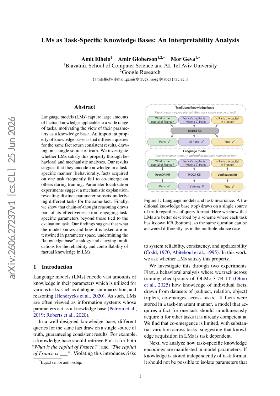
Key claim
Language models encode knowledge in a task-specific manner.
In plain English
Imagine you're building a system that relies on a language model to provide accurate information across various tasks, like answering customer queries or generating reports. You'd expect that if the model knows a fact, it should be able to retrieve it consistently, no matter the context. However, it turns out that language models often fail to do this. They might learn facts in a way that's specific to the task they were trained on, meaning that the same fact might not be accessible when asked in a different context. This inconsistency can lead to confusion and errors, especially if you're relying on the model for critical information. This issue is known as task-specific knowledge encoding, where the model's understanding is not universal but rather fragmented based on the tasks it has seen during training.
The authors of this paper took a closer look at this problem and found that the way language models store and retrieve knowledge is more complex than previously thought. They conducted experiments that showed how different parts of the model's parameters are activated depending on the task at hand. This means that when you ask a model to reason through a problem, it might engage different parameters than when it's simply recalling a fact. This intertwining of knowledge and task context suggests that the analogy of a language model as a reliable knowledge base is misleading.
In practical terms, this means that if you're building applications that depend on factual accuracy, you need to be aware that the model's responses may vary based on how you frame your questions. Understanding this can help you design better systems that account for these inconsistencies, ensuring that users get the most reliable information possible.
The paper provides significant insights into how language models encode knowledge differently across tasks, challenging the traditional view of them as consistent knowledge bases.
The findings are supported by behavioral and mechanistic analyses, though the scope of evaluation could be broader.
Deep reliability assessment
The methodology supports the narrower claim that, for well-known relational facts in 7B–13B instruction-tuned models, factual behavior and localized parameter dependence vary by task format. It overclaims if read as proving that all LM knowledge is stored in clean task-specific silos, since the localization masks show causal involvement but not a complete or unique representation of each fact.
Reproducibility
No code repository is mentioned in the provided paper text. Reproducibility is partially supported by using named public models such as OLMo-2/3 and Gemma-2 plus relational fact datasets, but exact prompts, checkpoint access, mask-training details, and filtering choices would be needed to fully replicate.
Key figure
Figure 1 contrasts a traditional knowledge base that answers all query formats from one shared fact store with a language model that may behave like separate task-specific knowledge bases for OpenQA, multiple choice, and verification.