
Energy-Structured Latent World Models with Neural Time Fields for Physically Constistent Open-World Motion Planning
Yapeng Liu, Yuanzhao Zhai, Bo Ding, Huaimin Wang, Lin Wang
Read on arXiv →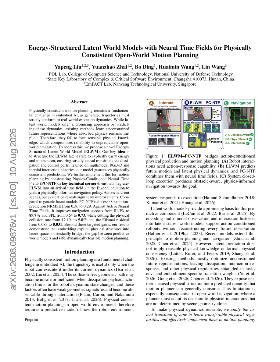
Key claim
Explicit physical structures improve AI motion planning.
In plain English
Imagine you're building a robot that needs to navigate through a complex environment, like a crowded room or an outdoor space. The challenge is ensuring that the robot's movements are not only efficient but also physically realistic, meaning it should avoid collisions and follow the laws of physics. Current methods often rely on latent world models that predict future states without explicitly considering how energy and momentum affect movement. This can lead to unrealistic trajectories and failures in unpredictable situations, which is a problem known as lack of physical consistency in motion planning.
To tackle this, the authors propose a new approach called the Energy-Structured Latent World Model (ELWM). The idea is to structure the model's latent state to explicitly include energy and momentum, which helps ensure that the robot's movements are causally linked to its physical environment. By training this model on multimodal data, including RGB-D images and inertial data, they create a system that can predict movements that are not only accurate but also physically plausible. The results show that their method significantly improves motion prediction accuracy and navigation success rates while reducing collision rates compared to existing models. For anyone building AI systems that need to operate in real-world environments, this approach offers a more reliable way to ensure that the AI behaves in a physically consistent manner.
The introduction of an Energy-Structured Latent World Model represents a significant advancement in motion planning by explicitly incorporating physical principles.
The evaluation metrics show substantial improvements over existing models, though the reliance on specific scenarios may limit generalizability.
Deep reliability assessment
The methodology supports physically consistent motion planning by structuring latent states with energy and momentum, but the claims of improved navigation success and reduced collision rates may be overclaimed without extensive real-world testing.
Reproducibility
No open source code or dataset is mentioned in the paper.
Key figure
Figure 1 illustrates how ELWM–PC-NTF bridges action-conditioned physical prediction and motion planning, showing the integration of robot interactions, future motion prediction, and neural time fields for navigation.