
Invariant Learning Dynamics of Transformers in Inductive Reasoning Tasks
Tiberiu Musat, Tiago Pimentel, Nicholas Zucchet, Thomas Hofmann
Read on arXiv →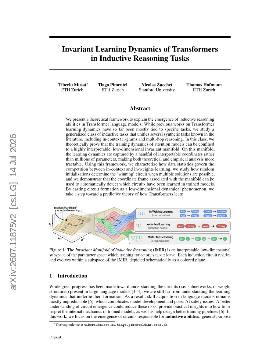
Key claim
Learning dynamics of Transformers can be simplified to low-dimensional manifolds.
In plain English
Inductive reasoning in Transformer models is not well understood, especially across various tasks. Current research often focuses on specific applications, making it hard to generalize findings. This paper introduces a framework that unifies different inductive tasks and simplifies the learning dynamics into a low-dimensional space. Builders might care because this could lead to more interpretable models and better insights into how Transformers learn from data.
Introduces a theoretical framework for understanding inductive reasoning in Transformers.
Provides theoretical proofs and empirical analysis, though lacks extensive real-world validation.
Deep reliability assessment
The methodology supports the theoretical framework for understanding inductive reasoning in Transformers, but the practical implications and generalizability to real-world tasks may be overclaimed.
Reproducibility
no
Key figure
Figure 1 illustrates the Invariant Manifold of Inductive Reasoning (IMIR) as an interpretable low-dimensional subspace of the parameter space where training trajectories remain confined.