
ARDY: Autoregressive Diffusion with Hybrid Representation for Interactive Human Motion Generation
Kaifeng Zhao, Mathis Petrovich, Haotian Zhang, Tingwu Wang, Siyu Tang, Davis Rempe
Read on arXiv →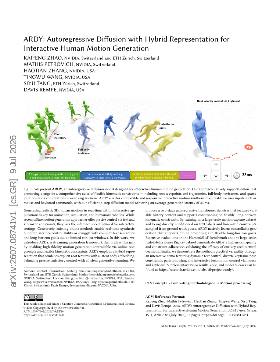
Key claim
ARDY enables real-time, controllable 3D motion generation.
In plain English
Imagine you're creating a video game or a simulation where characters need to move realistically in response to player commands. Traditionally, you could either generate these motions very accurately but slowly, or quickly but with less control over how they look and behave. This is a problem because players want both realism and responsiveness. The existing methods either take too long to compute or don't allow for complex movements based on detailed instructions, which is frustrating for developers and users alike. This is what's called a trade-off between speed and control.
Now, ARDY steps in as a solution to this issue. It allows for high-quality motion generation that can be controlled in real-time using text prompts and specific movement constraints. The clever part is how it combines different types of data: it uses both explicit features of the character's movements and a more abstract representation of the body. This hybrid approach means that it can generate motions that are not only fast but also precise and responsive to user input.
What sets ARDY apart from previous methods is its ability to handle complex instructions while still generating motions quickly. This means that developers can create more interactive and engaging experiences without sacrificing the quality of the animations. In practical terms, if you're building a game or a simulation, ARDY could allow you to create characters that move fluidly and respond to player actions in real-time, making for a much richer user experience.
ARDY introduces a new framework for real-time 3D motion generation that combines controllability with efficiency.
The claims are supported by extensive evaluations on established benchmarks and a clear methodology.
Deep reliability assessment
The methodology supports interactive human motion generation with real-time text prompting and kinematic constraints, but the reliance on past motion frames for context may limit efficiency in long-horizon tasks.
Reproducibility
No open source code or dataset is mentioned in the paper.
Key figure
Figure 1 illustrates ARDY, an autoregressive diffusion model for interactive human motion generation, supporting online text prompting and kinematic constraints with a 33 ms latency.