
GaP: A Graph-as-Policy Multi-Agent Self-Learning Harness For Variational Automation Tasks
Kaiyuan Chen, Shuangyu Xie, Letian Fu, Justin Yu, William Pacini, Sandeep Bajamahal, Hudson Kim, Jaimyn Drake, Daehwa Kim, Haoru Xue, Jonathan Francis, Christian Juette, Peter Schaldenbrand, Muhammet Yunus Seker, Ruwan Wickramarachchi, Uksang Yoo, Guanzhi Wang, Adithyavairavan Murali, Balakumar Sundaralingam, S. Shankar Sastry, Spencer Huang, Yuke Zhu, Linxi "Jim" Fan, Ken Goldberg
Read on arXiv →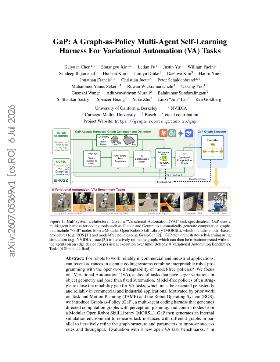
Key claim
GaP significantly improves robot task success rates.
In plain English
Imagine you're trying to get robots to perform tasks in unpredictable environments, like a factory where the objects they handle can vary widely in shape and position. Traditional programming methods often struggle here because they rely on fixed rules and can't adapt to new situations. This leads to failures when the robot encounters something it wasn't specifically programmed for — a problem known as rigidity in automation.
To tackle this, people have been using model-free policies, which allow robots to learn from experience rather than just following pre-set instructions. However, these policies can still fall short in reliability, especially when tasks need to be performed consistently over time. This is what's called the reliability gap.
The authors introduce a solution called Graph-as-Policy (GaP), which creates a flexible coding framework that generates computation graphs tailored to specific tasks. It combines perception, planning, and control in a way that allows robots to rehearse different task scenarios in a simulated environment before executing them in the real world. This iterative refinement process helps improve the robot's success rates significantly.
In practical terms, GaP allows robots to adapt to new tasks more effectively than previous methods, making them more reliable in commercial and industrial settings. The evaluation shows that GaP outperforms existing baselines across multiple benchmarks, which is crucial for anyone looking to deploy robots in dynamic environments.
The approach introduces a new coding harness that combines multiple advanced techniques for robot programming.
The evaluation includes multiple benchmarks and real-world testing, supporting the claims made.
Deep reliability assessment
The methodology supports the claim that GaP can outperform baselines in VA tasks, but the paper overclaims by suggesting it is ready for industry-level reliability without addressing execution time and dynamic task challenges.
Reproducibility
Yes, the paper mentions that details, code, and data will be posted online at https://graph-robots.github.io/gap.
Key figure
Figure 1 illustrates the GaP system architecture, showing how a multi-agent harness generates computation graphs for VA tasks using a Modular Open Robot Skill Library and self-learning through simulation.