
Bridging Talk and Thought: Understanding Dialogue Dynamics Across Collaborative Problem-Solving Contexts
Zhengyuan Liu, Stella Xin Yin, Min-Yen Kan, Nancy F. Chen
Read on arXiv →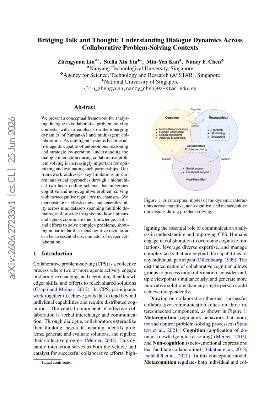
Key claim
Metacognitive regulation is key for effective human-AI collaboration.
In plain English
Imagine you're trying to build a system where humans and AI work together to solve problems, like planning a project or troubleshooting a technical issue. The challenge is that communication between humans and AI can be tricky; misunderstandings can lead to inefficiencies or even failure to solve the problem at hand. Current methods often fall short because they don't fully capture the nuances of these interactions, especially when it comes to how people think about their own thinking — a concept known as metacognition. This is what's called a limitation in existing analytical approaches.
To address these issues, the authors propose a new framework that looks at dialogue in a structured way, breaking it down into two layers. The first layer focuses on cognitive aspects, like the actual problem-solving strategies used, while the second layer incorporates metacognitive elements, which help regulate and improve the collaboration process. This dual approach allows for a more comprehensive understanding of how humans and AI can effectively coordinate their knowledge and skills.
What sets this work apart from previous studies is its emphasis on metacognitive regulation as a crucial factor for deeper collaboration. By applying this framework across nine different datasets, the authors demonstrate that it not only helps in analyzing dialogue but also enhances the overall effectiveness of human-AI partnerships. For anyone building systems that rely on collaboration between humans and intelligent agents, this framework offers valuable insights into optimizing those interactions.
The framework introduces a new way to analyze dialogue in collaborative problem-solving, extending existing methods.
The claims are supported by multiple datasets and a clear methodology, demonstrating effectiveness.
Deep reliability assessment
The methodology supports the paper's main contribution as a conceptual and annotation framework for describing collaborative dialogue across multiple domains. The stronger claim that metacognitive regulation is an essential discriminator of deeper collaboration is plausible but overclaimed unless tied to outcome quality, longitudinal collaboration success, or causal interventions.
Reproducibility
No open-source code or repository is mentioned in the provided text. The paper says it evaluates across nine datasets and uses English-language samples, but the excerpt does not provide a reproducible pipeline, annotation release, or project URL.
Key figure
Figure 1 depicts collaborative problem solving as an interaction among metacognition, cognition, and non-cognition, with metacognitive regulation monitoring and controlling both task reasoning and socio-emotional collaboration dynamics.