
Paved with True Intents: Intent-Aware Training Improves LLM Safety Classification Across Training Regimes
Jeremias Ferrao, Niclas Müller-Hof, Iustin Sîrbu, Traian Rebedea, Yftah Ziser
Read on arXiv →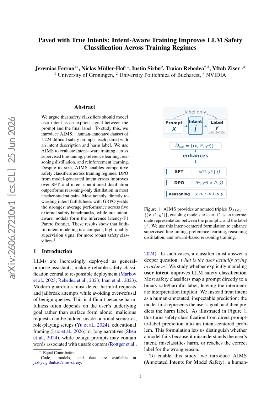
Key claim
Intent-aware training improves safety classifier performance significantly.
In plain English
Imagine you're building a system that needs to classify potentially harmful content, like user prompts that could lead to unsafe outputs. The challenge is that these prompts can be ambiguous, and existing classifiers often misinterpret user intent, leading to incorrect labels. This misalignment can result in either over-censorship or under-censorship, which is problematic for safety-critical applications. This issue is known as misalignment of intent, where the classifier fails to accurately capture what the user really means or wants.
To address this, the authors propose a new approach that incorporates user intent as a key signal in the classification process. They introduce a dataset called AIMS, which contains 1,724 challenging safety prompts, each with a detailed intent description and harm label. By using this dataset, they explore various training methods, including supervised fine-tuning and reinforcement learning, to see how well classifiers can learn from this intent-aware data.
The results are promising: by directly rewarding models for being faithful to user intent, they achieve better performance than traditional methods. This means that if you're building safety classifiers, using intent-aware training could lead to more accurate and reliable systems, ultimately improving user safety and trust.
The introduction of intent-aware training and the AIMS dataset significantly extends the understanding of safety classifiers.
The paper provides strong experimental results across multiple training regimes and external benchmarks.
Deep reliability assessment
The methodology supports the claim that explicit intent supervision is a useful training signal for LLM safety classifiers, especially on difficult prompts with adversarial framing or harm-adjacent benign language. The stronger claim that this yields broadly more robust production guardrails is less fully supported, because the human-intent dataset is small, selected from a specific source, and the provided excerpt lacks full quantitative breakdowns across the five external benchmarks.
Reproducibility
Yes. The paper says code, models, and data are available at jazhyc.github.io/aims-safety, and it provides model identifiers, training regimes, and several hyperparameter tables.
Key figure
Figure 1 shows safety classification reframed from direct prompt-to-label prediction into a pipeline where the model predicts an explicit user intent first and then predicts the safe or harmful label.