
The Tatoxa System for Text Detoxification in Low-Resource Languages: The Case of Tatar
Ilseyar Alimova, Bogdan Monogov, Artyom Mazur, Daniil Antonov, Vsevolod Karimov, Vitaliy Egorov, Bulat Khakimov, Alexander Panchenko
Read on arXiv →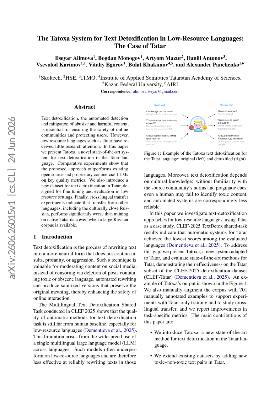
Key claim
Tatoxa outperforms existing models for Tatar text detoxification.
In plain English
Imagine you're trying to create a safe online space where users can communicate without encountering abusive language. This is a big challenge, especially for languages that don't have a lot of resources or research behind them, like Tatar. Currently, many systems that detect harmful content are built for widely spoken languages, leaving smaller languages underserved. This can lead to situations where harmful content slips through the cracks, which is what's called a lack of support for low resource languages.
Tatoxa steps in as a solution to this problem. It’s designed specifically for the Tatar language and aims to automatically identify and reduce abusive content. The system has been tested against both open-source and commercial models, and it shows better performance on key quality metrics. This means that it can more effectively keep online communities safe for Tatar speakers.
Additionally, the authors have created a new dataset tailored for text detoxification in Tatar, which is essential for training and evaluating models in low resource settings. They found that using data from other languages, even closely related ones like Russian, doesn't work as well as training on native Tatar data. This insight is important because it highlights the need for dedicated resources for low resource languages, ensuring that they can be effectively supported in online environments.
The introduction of a novel system for text detoxification in a low resource language represents a significant extension of existing methods.
The paper provides comparative experiments against existing models and introduces a new dataset, supporting its claims.
Deep reliability assessment
The methodology supports the narrower claim that language-specific supervision and synthetic Russian-to-Tatar detoxification data can improve Tatar detoxification relative to generic multilingual or zero-shot LLM approaches. The stronger claim that Tatoxa is broadly state-of-the-art is harder to assess from the provided text because the concrete metric table, human evaluation details, and production-like moderation setting are not shown.
Reproducibility
Yes. The paper says source code and dataset are openly available, and provides a GitHub repository in a footnote: https://github.com/s-nlp/tatoxa.
Key figure
Figure 1 shows an example Tatar input sentence with toxic wording on the left and Tatoxa's neutralized rewrite on the right.