
Autodata: An agentic data scientist to create high quality synthetic data
Ilia Kulikov, Chenxi Whitehouse, Tianhao Wu, Yixin Nie, Swarnadeep Saha, Eryk Helenowski, Weizhe Yuan, Olga Golovneva, Jack Lanchantin, Yoram Bachrach, Jakob Foerster, Xian Li, Han Fang, Sainbayar Sukhbaatar, Jason Weston
Read on arXiv →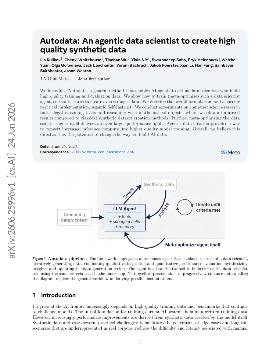
Key claim
AI agents can autonomously create high-quality training data.
In plain English
Imagine you're trying to build AI models that can learn from the best possible data. Traditionally, creating high-quality training datasets is a manual and often flawed process. You might end up with data that doesn't represent the real-world scenarios your model will face, leading to poor performance. This is what's called data quality issues, and it can happen when the data is either too synthetic or not diverse enough to cover all use cases.
Now, what if you had an AI agent that could act like a data scientist? Instead of relying on humans to curate datasets, this agent could learn to generate high-quality training and evaluation data on its own. This is where the paper's approach comes in. They introduce a method called Agentic Self-Instruct, which trains an AI to create better data by learning from its own performance. The idea is that by optimizing the agent's ability to generate data, you can significantly improve the quality of the datasets it produces.
In practical terms, this means that when you deploy AI models, you can expect them to perform better because they are trained on data that is more representative of the tasks they will encounter. The experiments conducted show that this method outperforms traditional synthetic dataset creation techniques, making it a valuable tool for anyone looking to enhance their AI training processes.
The method introduces a new approach to data creation that enhances AI training.
The experiments show improved results across multiple tasks, supporting the claims made.
Deep reliability assessment
The provided text supports the claim that Autodata is a general agentic loop for synthetic data creation and that the authors evaluated it across computer science research, legal reasoning, and mathematical-object reasoning tasks. It overclaims relative to the excerpt by asserting broad potential to change AI data creation without showing concrete quantitative results, ablations, cost analysis, or failure cases in the supplied sections.
Reproducibility
No open source code, dataset release, or project URL is mentioned in the provided abstract, introduction, results excerpt, limitations excerpt, or conclusion excerpt.
Key figure
Figure 1 shows an autonomous data-scientist agent cycling through grounded data creation, qualitative inspection, quantitative evaluation, insight synthesis, and recipe updates, with an outer loop that meta-optimizes the agent itself.