
Event Detection for Parameter-to-KPI Dependency Learning for AI-RAN
Christie Djidjev, Nicholas Kaminski
Read on arXiv →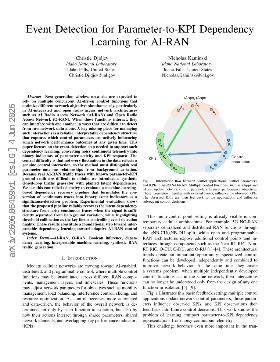
Key claim
The method reliably detects control interactions in noisy network data.
This paper presents a method for detecting control interactions in AI-driven wireless networks. The key result is that the proposed pipeline can reliably recover latent dependencies from noisy telemetry data, which is crucial for optimizing network performance.
In plain English
The authors developed a new approach to identify how different control parameters in wireless networks affect performance. Unlike previous methods that struggled with noisy data, their technique uses a synthetic traffic generator to create clear examples of these interactions. This is important because understanding these dependencies can help improve network management and performance. Builders should care because better dependency detection can lead to more efficient and reliable wireless networks.
The paper introduces a novel method for dependency learning in AI-RAN systems, extending existing approaches to network optimization.
The experimental evaluation is solid, demonstrating the method's effectiveness with controlled synthetic data.
Deep reliability assessment
The methodology supports a controlled proof-of-concept that threshold-based event detection can recover planted parameter-to-KPI dependencies in synthetic closed-loop AI-RAN telemetry when signal and noise are sufficiently separable. It does not yet support strong claims about real AI-RAN/O-RAN deployments, because the evaluation appears to rely on synthetic traces with known latent dependencies rather than field data with operational confounders, nonstationarity, and real controller behavior.
Reproducibility
No open-source code repository or released dataset is mentioned in the provided abstract, introduction, conclusion, or visible text. The paper describes a synthetic closed-loop traffic generator, but no public implementation or trace release is identified.
Discussion questions
- 1.Does converting continuous network telemetry into binary event indicators discard too much information to reliably capture subtle or delayed parameter-to-KPI effects in real AI-RAN systems?
- 2.If you were building xApps/rApps for a live O-RAN deployment, how would you calibrate detection thresholds online as traffic mix, topology, and control policies change?
- 3.What real-world observation would falsify the paper's result: failure to recover known controller-KPI dependencies under realistic noise, lag, hidden confounding, or multi-controller feedback loops?
Key figure
Figure 1 depicts a feedback loop in AI-RAN/O-RAN where multiple control applications such as xApps and rApps update control parameters, those parameters and external events affect KPIs, and KPI observations feed back into future control decisions.