
AlphaTransit: Learning to Design City-scale Transit Routes
Bibek Poudel, Sai Swaminathan, Weizi Li
Read on arXiv →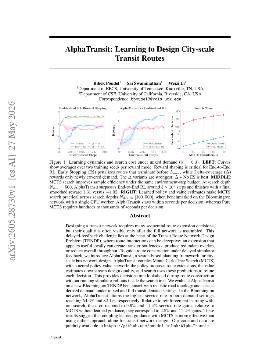
Key claim
AlphaTransit significantly improves transit network design efficiency.
AlphaTransit is a new framework for designing city-scale bus networks that effectively combines Monte Carlo Tree Search with a neural policy-value network. It achieves significant service rate improvements over existing methods, demonstrating its effectiveness in real-world transit scenarios.
In plain English
The authors developed AlphaTransit, a new framework for designing bus networks in cities that combines a method called Monte Carlo Tree Search (MCTS) with a neural network that predicts the quality of route designs. Unlike previous methods that often relied solely on trial and error, AlphaTransit uses learned insights to make better decisions about where to extend bus routes, leading to significant improvements in service rates. This means that cities can create more efficient transit systems that better meet the needs of their populations. Builders should care because this approach not only enhances the design process but also has the potential to improve public transportation accessibility and efficiency, making it a valuable tool for urban planners and transit authorities.
AlphaTransit introduces a novel search-based planning framework that combines MCTS with a neural network for transit network design.
The paper provides strong experimental results on a new benchmark and releases code and data, supporting its claims effectively.
Deep reliability assessment
The methodology supports the claim that combining learned guidance with MCTS improves transit network design efficiency, but the results may not generalize beyond the specific benchmarks used.
Reproducibility
yes, the code and data are publicly available at https://github.com/poudel-bibek/AlphaTransit.
Discussion questions
- 1.How does the assumption of starting all routes at a transit-center hub affect the generalizability of the results to other city layouts?
- 2.What are the practical implications of implementing AlphaTransit in real-world transit planning, considering factors like budget and political constraints?
- 3.What specific conditions or results would falsify the claim that AlphaTransit achieves the highest service rate among evaluated methods?
Key figure
Figure 1 illustrates the learning dynamics and search cost of AlphaTransit compared to End-to-End RL under mixed demand conditions.